Can Flood-Damaged Carpet Be Saved? What Perth Homeowners Need to Know
When flooding hits your home, the carpet is usually the first casualty. Whether it's a burst pipe in Subiaco, a storm surge in Cottesloe, or a dishwasher overflow in Mount Lawley, the question that follows is always the same: can the flood damaged carpet be saved, or is it heading to landfill? The answer depends on several factors, and getting it right matters far more than most people realise. Flood damaged carpet that's handled quickly and correctly can often be fully restored. Flood damaged carpet that's left to sit, or dried out improperly, can become a costly and potentially dangerous problem.
See below the topics that will be covered in this blog post about "Can Flood-Damaged Carpet Be Saved? What Perth Homeowners Need to Know":
- Can flood-damaged carpet actually be saved, or does it always need replacing?
- How quickly does wet carpet need to be treated to avoid permanent damage?
- What are the health risks of leaving water-damaged carpet untreated?
- How do professionals dry and restore flood-damaged carpet in Perth?
- When does mould become a problem after carpet water damage?
- What's the difference between a carpet that can be restored and one that can't?
- Does home insurance in Western Australia cover flood-damaged carpet?
- Why is professional emergency carpet cleaning better than DIY drying?
- Conclusion
If you've just discovered water-soaked floors and you're not sure where to start, keep reading. The decisions you make in the next few hours can determine whether your flood damaged carpet is salvageable or a write-off.
Can Flood-Damaged Carpet Actually Be Saved, or Does It Always Need Replacing?
The short answer is: it depends, and the most important variable is time. Flood damaged carpet is not automatically ruined. Many homeowners in Scarborough, Victoria Park, Applecross and across Perth have had their carpets professionally restored after significant water events, with no lasting damage to the fibres, the underlay, or the subfloor beneath. But that outcome requires fast action and the right approach.
What actually determines whether flood damaged carpet can be saved comes down to three things: the source of the water, how long the carpet has been wet, and whether the underlay beneath it has also been saturated.
Water source matters enormously: Professionals categorise flood water into three types. Category 1 is clean water from a supply pipe or rainwater, this is the most manageable and gives the best chance of saving flood damaged carpet. Category 2, sometimes called grey water, comes from appliances like washing machines or dishwashers and contains some contaminants. Category 3 is black water: sewage, river flooding, or stormwater carrying debris and bacteria. Flood damaged carpet affected by Category 3 water almost always needs to be replaced, regardless of how quickly it's treated, because the contamination risk is simply too high to remediate safely.
Saturation time is critical: A carpet that has been wet for two hours is a very different problem to one that's been wet for 48 hours. In the early stages, the fibres and backing retain their structure and the risk of microbial growth is still relatively low. The longer flood damaged carpet stays wet, the more the backing breaks down, the more the adhesive releases, and the more opportunity there is for bacteria and mould to establish. Water damage restoration specialists generally consider the first 24 to 48 hours the window in which flood damaged carpet has the best chance of being fully restored.
Underlay is rarely salvageable: Even when the carpet itself can be saved, the foam or felt underlay beneath it typically cannot. Underlay absorbs and retains water far more aggressively than carpet fibres, and drying it out completely while it's still in place is almost impossible. Most reputable restorers will lift flood damaged carpet, remove and discard the underlay, dry the subfloor thoroughly, and relay the carpet over new underlay once everything is confirmed dry.
The good news for Perth homeowners is that with prompt professional attention, a large proportion of flood damaged carpet situations are resolvable without replacement. But the clock starts the moment water hits the floor.
How Quickly Does Wet Carpet Need to Be Treated to Avoid Permanent Damage?
Speed is not just important when it comes to flood damaged carpet, it's everything. The difference between a carpet that can be restored and one that cannot often comes down to whether treatment started within the first few hours or was delayed by a day or more.
Within the first two hours, flood damaged carpet is in its best possible condition for recovery. The fibres are wet but the structure is largely intact, microbial growth hasn't had time to take hold, and the underlay, while saturated, hasn't yet begun to break down in ways that contaminate the carpet above it. This is the window where professional emergency carpet cleaning in Perth delivers the best outcomes.
Between two and 24 hours, the risks multiply. Bacteria begin to proliferate in the warm, moist environment that wet carpet creates. The backing material on flood damaged carpet starts to delaminate, essentially separating from the face fibres, which weakens the carpet's structural integrity and can make it impossible to restore even if it's dried out. Odours begin to develop. If the weather is warm, as it frequently is in Perth, this process accelerates significantly.
Beyond 48 hours, flood damaged carpet enters a different category of problem. Mould can begin to colonise the underlay and the back of the carpet within this timeframe under the right temperature and humidity conditions. At this point, the question is no longer just about restoring the carpet, it's about whether the environment beneath it has become a health hazard. Flood damaged carpet left wet for 72 hours or more in a Perth summer is a serious mould risk, and in many cases, replacement becomes the only responsible option.
The practical takeaway for homeowners in South Perth, Fremantle, Hillarys, Joondalup and surrounding suburbs is straightforward: if flood damaged carpet is going to be saved, the phone call to a professional needs to happen immediately, not after you've spent a day trying to dry things out yourself with a household fan.
What Are the Health Risks of Leaving Water-Damaged Carpet Untreated?
Flood damaged carpet is not just a cosmetic or financial problem. Left untreated, it can become a genuine health risk for everyone in the household, particularly children, elderly residents, and anyone with respiratory conditions or allergies.
The most significant concern is mould. When flood damaged carpet stays wet long enough for mould spores to germinate and spread, the resulting growth releases mycotoxins and allergens into the indoor air. Mould exposure is a known trigger for asthma attacks, allergic rhinitis, and other respiratory problems. In a closed home environment, mould growing beneath or within flood damaged carpet can circulate through the air every time someone walks across the room. For families in Mount Lawley, Applecross or Subiaco with young children or asthma sufferers, this is not a minor risk.
Beyond mould, untreated flood damaged carpet can harbour bacteria from the water source itself. Category 2 and Category 3 flood water carries pathogens that can survive in carpet fibres and underlay long after the visible water has dried. Skin contact with contaminated flood damaged carpet, particularly common in homes with young children who crawl or sit on the floor, creates a direct exposure risk.
There are also longer-term structural concerns. Flood damaged carpet that dries out while still in contact with the subfloor can trap moisture in the timber or concrete beneath it, leading to subfloor rot, structural weakening, and persistent damp odours that are extremely difficult to eliminate after the fact. Addressing the flood damaged carpet quickly is as much about protecting the building as it is about protecting the carpet itself.
Perth Local Carpet Cleaning regularly responds to water damage situations across Osborne Park, Malaga, Wangara, Bibra Lake, Welshpool and the wider metro area. In every case, getting a professional team on site quickly is the most effective way to contain the health and structural risks that flood damaged carpet creates.
How Do Professionals Dry and Restore Flood-Damaged Carpet in Perth?
Professional water damaged carpet restoration in Perth is a structured, multi-stage process that goes well beyond placing a few fans around the room. When Perth Local Carpet Cleaning responds to a flood damaged carpet situation, the team follows a systematic approach designed to fully restore the carpet while protecting the subfloor and the indoor air quality of the home.
The process typically works as follows:
- Assessment and water classification. Before anything else, the technician inspects the flood damaged carpet and the surrounding area to determine the source and category of the water. This assessment drives every decision that follows, from the cleaning products used to whether the carpet can be saved at all.
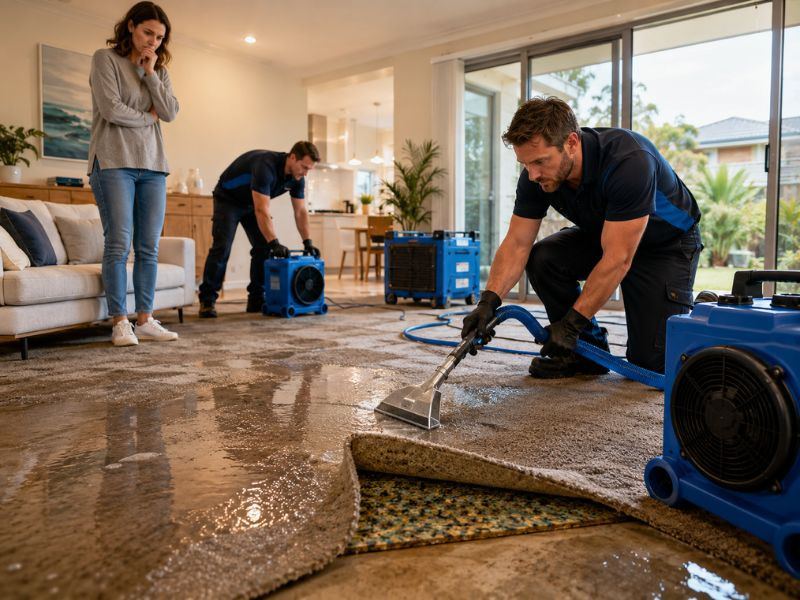
- Water extraction. Using truck-mounted extraction equipment, professionals remove standing water and moisture from flood damaged carpet at a rate and depth that no domestic wet-dry vacuum can match. The truck-mounted systems used by Perth Local Carpet Cleaning generate significantly more suction power than portable alternatives, extracting water not just from the surface of the carpet but from deep within the fibres and backing. You can read more about this equipment on the Perth Local Carpet Cleaning steam cleaning page.
- Lifting and underlay removal. In most flood damaged carpet scenarios, the carpet is carefully lifted from the floor and the saturated underlay removed. The underlay is almost always discarded, as it cannot be dried or cleaned to a standard that makes retention safe or practical.
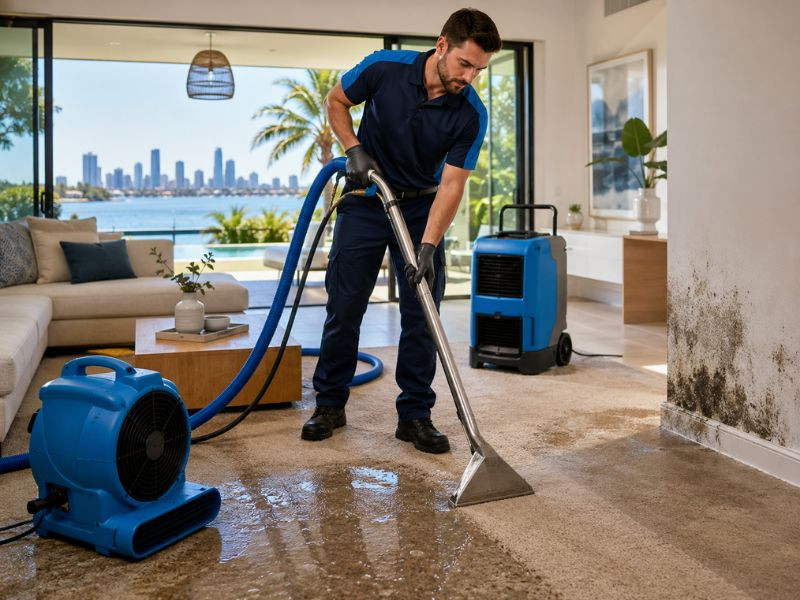
- Subfloor drying. The concrete slab or timber subfloor beneath the flood damaged carpet is then dried using industrial air movers and dehumidifiers. This step is non-negotiable, reinstalling carpet over a wet subfloor simply transfers the moisture problem rather than solving it.
- Cleaning and sanitising. The underside and face fibres of the flood damaged carpet are treated with professional-grade cleaning and antimicrobial solutions to address bacteria, odours, and early-stage biological growth. Steam carpet cleaning is often used at this stage, as the high-temperature process is highly effective at neutralising contaminants.
- Drying, re-laying, and final inspection. Once the carpet is cleaned and the subfloor confirmed dry, new underlay is installed and the carpet is re-laid, re-stretched and inspected. Moisture meters are used throughout the process to verify that drying targets have been met.
This is a far cry from pointing a fan at a wet floor and hoping for the best, and it's the reason professional water damaged carpet restoration in Perth consistently achieves results that DIY efforts simply cannot.
When Does Mould Become a Problem After Carpet Water Damage?
Mould is the question that sits behind every flood damaged carpet situation, and the timeline is shorter than most homeowners expect. Under the right conditions, warmth, moisture, and an organic material to feed on, mould spores can begin to germinate within 24 to 48 hours of water exposure. In the Perth climate, where indoor temperatures can remain warm even overnight, this window can be even tighter.
Carpet mould after water damage doesn't always announce itself visibly, at least not straight away. The first signs are usually olfactory, a musty, earthy smell that seems to come from the floor. By the time visible mould growth appears on or beneath flood damaged carpet, the problem has typically been developing for days. The mould you can see is rarely all of it; growth in the underlay and on the subfloor beneath is often more extensive than what appears on the surface.
Several factors affect how quickly carpet mould after water damage develops:
- Temperature: Mould thrives between 20°C and 30°C, a range that Perth sits comfortably within for much of the year, particularly in the northern suburbs like Joondalup, Hillarys, and Wangara.
- Ventilation: Flood damaged carpet in a well-ventilated room dries faster and gives mould less opportunity to establish. Carpets in enclosed spaces, under furniture, or in rooms with poor airflow are at much higher risk.
- Carpet type: Natural fibre carpets (wool, cotton, sisal) are more prone to mould growth than synthetic alternatives (nylon, polyester) because they provide a more nutritious substrate for mould organisms.
- Underlay material: Foam underlay is particularly prone to retaining moisture and supporting mould growth, which is one of the reasons it's nearly always replaced rather than dried in place.
If you suspect carpet mould after water damage in your home, do not delay. Perth Local Carpet Cleaning's water damage restoration service includes mould assessment and treatment as part of the restoration process. Attempting to remove mould from flood damaged carpet without professional equipment and antimicrobial treatments risks spreading spores further through the home rather than eliminating them.
What's the Difference Between a Carpet That Can Be Restored and One That Can't?
Not every flood damaged carpet is a restoration candidate, and knowing the difference before a professional arrives can help homeowners set realistic expectations. Several clear indicators separate a carpet that can be saved from one that's reached the end of its life.
Carpets that are strong candidates for restoration:
- Affected by Category 1 (clean) water only
- Treated within 24 to 48 hours of the water event
- Made from synthetic fibres (nylon, polyester, polypropylene) which resist microbial growth better than natural fibres
- In otherwise good condition prior to the water event, not aged, worn, or previously damaged
- Free from visible mould growth on the face fibres
Carpets that are typically beyond restoration:
- Exposed to Category 3 water (sewage, stormwater, river flooding), contamination in these cases is too deep and too hazardous to remediate cost-effectively
- Left wet for more than 48 to 72 hours, particularly in warm conditions
- Showing visible or detectable mould growth on the back of the carpet
- Experiencing delamination, where the backing has separated from the face fibres, causing the carpet to feel loose, wrinkled, or unstable underfoot
- Already aged or near end of life, restoration costs that approach or exceed replacement costs rarely make financial sense
There's also a practical cost consideration. When the expense of professional water damaged carpet restoration in Perth is close to or greater than the cost of new carpet and installation, replacement often becomes the more sensible option. A reputable company will give you an honest assessment rather than proceeding with restoration that isn't going to deliver a satisfactory result.
Perth Local Carpet Cleaning provides honest, experienced assessments of flood damaged carpet across Victoria Park, Cottesloe, Fremantle, Scarborough and the broader metropolitan area. If restoration is achievable and cost-effective, the team will say so. If it isn't, they'll tell you that too.
Does Home Insurance in Western Australia Cover Flood-Damaged Carpet?
Home insurance and flood damaged carpet is a topic that trips up a lot of Perth homeowners, largely because the coverage depends heavily on the specific policy and the cause of the water damage, not simply the fact that the carpet got wet.
What is typically covered:
Most home contents insurance policies in Western Australia will cover flood damaged carpet resulting from sudden, accidental events, things like a burst pipe, an overflowing bath, or storm water entering through a damaged roof. In these situations, the carpet is considered an insured item and the water damage restoration cost may be claimable, subject to your excess.
What is often excluded:
The word "flood" in insurance policies is frequently defined more narrowly than homeowners expect. Many policies exclude damage caused by the overflow of rivers, lakes, or stormwater drains, sometimes referred to as "defined flood events", unless flood cover has been specifically added to the policy. Damage caused by gradual leaks, rising damp, or maintenance failures is also typically excluded. If flood damaged carpet is the result of a long-running plumbing problem that was known and unaddressed, it's unlikely to be covered.
Steps to take:
- Contact your insurer immediately and document the damage thoroughly with photographs before any cleaning or restoration work begins
- Request written confirmation of what is and isn't covered before committing to restoration costs
- Keep all invoices and reports from your water damaged carpet restoration provider, as these may be required as part of your claim
Perth Local Carpet Cleaning is experienced in working alongside insurance assessors and can provide the documentation required to support a valid claim.
Why Is Professional Emergency Carpet Cleaning Better Than DIY Drying?
When flood damaged carpet is discovered, the instinctive response for many homeowners is to reach for towels, open the windows, and drag out whatever fans or heaters are available. It's a natural reaction, but it's also one of the least effective approaches to the problem, and in some cases, it makes things worse.
Here's why professional emergency carpet cleaning in Perth consistently outperforms DIY drying for flood damaged carpet:
- Equipment capability: The gap between domestic fans and professional extraction and drying equipment is enormous. Industrial air movers shift volumes of air that household fans simply cannot match, and dehumidifiers designed for water damage restoration can extract litres of moisture from the air per hour. The truck-mounted systems used by Perth Local Carpet Cleaning extract water from deep within carpet fibres at a level of efficiency that makes DIY efforts look negligible by comparison.
- Drying the right things: DIY efforts typically focus on the visible surface of flood damaged carpet, the face fibres that feel wet underfoot. Professional restoration focuses on the entire system: the face fibres, the backing, the underlay, and critically, the subfloor beneath. Surface drying that leaves the subfloor wet creates a long-term moisture reservoir that feeds mould growth for months after the visible water has disappeared.
- Antimicrobial treatment: Drying flood damaged carpet without treating it for bacteria and biological contaminants doesn't solve the contamination problem, it just leaves behind a dry version of it. Professional emergency carpet cleaning in Perth includes application of industry-grade antimicrobial solutions that neutralise pathogens and prevent the microbial growth that causes persistent odours and health risks.
- Moisture verification: How do you know when flood damaged carpet and its subfloor are actually dry? Professionals use calibrated moisture meters to measure moisture content at multiple points through the floor system and confirm that drying targets have been met. Without this step, it's easy to assume the carpet is dry when moisture is still trapped in the underlay or subfloor below.
- Time and stress: Managing flood damaged carpet recovery across multiple days with domestic equipment, while also dealing with the broader disruption of a water event, is exhausting and often inconclusive. Professional emergency carpet cleaning in Perth gets the job done faster, with greater certainty, and frees the homeowner to focus on the many other things that need attention after a flood.
Perth Local Carpet Cleaning provides emergency response across Perth CBD, Osborne Park, Welshpool, Malaga, Wangara, Joondalup, Bibra Lake and all residential suburbs including Subiaco, Cottesloe, Scarborough, South Perth, Applecross, Fremantle, Mount Lawley, Victoria Park and Hillarys.
Conclusion
Perth Local Carpet Cleaning takes pride in delivering this content to you! In this blog post, you've read everything you need to know about "Can Flood-Damaged Carpet Be Saved? What Perth Homeowners Need to Know". We covered whether flood damaged carpet can actually be saved or needs replacing, how quickly wet carpet must be treated to avoid permanent damage, the health risks of leaving water damaged carpet untreated, how professionals dry and restore flood damaged carpet in Perth, when mould becomes a problem after carpet water damage, the difference between a carpet that can be restored and one that can't, what home insurance in Western Australia typically covers for flood damaged carpet, and why professional emergency carpet cleaning delivers better outcomes than DIY drying. Keep following the Perth Local Carpet Cleaning blog for more tips and updates.
Content developed by Perth Local Carpet Cleaning.
Flood damaged carpet is a time-sensitive problem that requires the right equipment, the right knowledge, and a fast response. Perth Local Carpet Cleaning provides professional water damage cleaning and restoration across the entire Perth metropolitan area, backed by truck-mounted technology, experienced technicians, and a commitment to honest, results-driven service. Whether you're dealing with a burst pipe in Subiaco, storm damage in Joondalup, or a Category 1 water event anywhere across Perth, our team is ready to help. Don't wait until the damage becomes irreversible. Visit our contact page to book an emergency assessment today.